Don’t Let an Aggressive Guard Dog In!

The best family protection dogs are friendly, not aggressive!

Countless people, often times children, become victims of severely disfiguring and traumatic dog bites from aggressive guard dogs. How do aggressive guard dogs differ from true personal protection dogs? Aggressive guard dogs are chosen for their ability to intimidate people, usually based on the dog’s aggressive reactions such as barking and showing teeth to human beings. These dogs are not stable, nor have they been given much (if any) formal training. While a dog with aggression issues might be a good way to scare away wanted or unwanted visitors, they will also be a liability and nuisance around the home. They lack the correct characteristics like proper temperament, socialization, genetics and training to make them functional protection dogs. Aggressive guard dogs are unpredictable and dangerous.

Why do people buy these kinds of guard dogs? Unfortunately, it’s much easier and cheaper to find a dog with the characteristics of an aggressive guard dog. Those who sell these types of dogs make a quick sale and aren’t concerned with how the dog will integrate into a family’s home. The dog’s energy level probably won’t match the buyer, and the dog won’t really do what it is expected to do. Dog aggression issues are often rooted in fear and insecurity. By contrast, our trained protection dogs are immensely confident and can back up their barking with skilled protection techniques. These dogs are better at making their owners and neighbors uneasy than they are of actually stopping a crime.

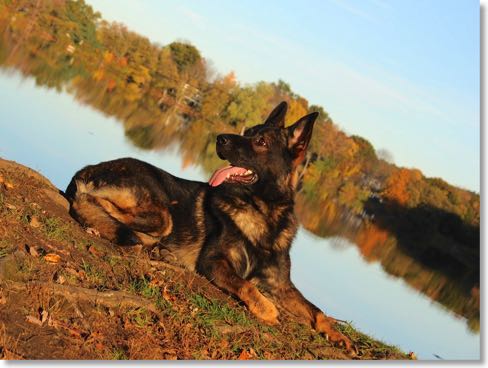
True professionals sell fully trained protection dogs that demonstrate the balance between protectiveness and companionship. Our dogs are social, well behaved, controlled, predictable, and only display aggression when it is asked of them. Once we’ve crafted a protection dog with these qualities, we turn our attention to the matching process. We find the dog that is right for each family situation and lifestyle, and these clients take delivery of a protector that they can feel excited to have around. Watch the delivery of Hans, a sable German Shepherd that we delivered to a family in Idaho. See the difference between an aggressive guard dog and a fully trained protection dog like Hans.

If you’re looking for a family guard dog, do your research. Learn as much as you can and talk to different people to get an idea of what you are looking for and what is available to you. Once you have narrowed down your list of sellers, write down any and all questions you have and contact each seller. Ask to see their training facility and speak to references. Anyone can put a website online and sell “personal protection dogs,” but offering a legitimate security solution is something else entirely. Find out which sellers are out to make a quick buck and which ones have the resources, facilities, equipment and experience to train these dogs.

At Protection Dogs Plus, we always encourage our clients to do their research. Our clients tend to be well informed- generally they’ve already been talking to 5 or more other protection dog trainers before discovering us. We show them our training facility, they get to meet our dogs, and they get to see the training first hand. Our dogs are backed by a full contract and warranty to ensure that you are not stuck with a dog you’re not happy with. We’re not a fly-by-night operation. We care about our clients, we care about our reputation and we care about our protection dogs. Once you’ve done other research, see our trained protection dogs for sale and contact us.
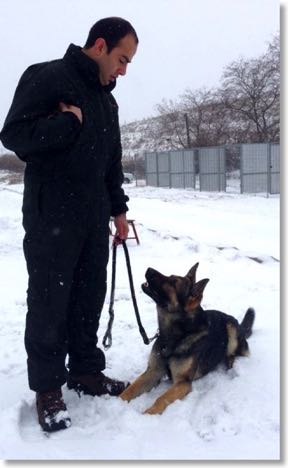
“Alpha Dogs” Are No Personal Protection Dogs

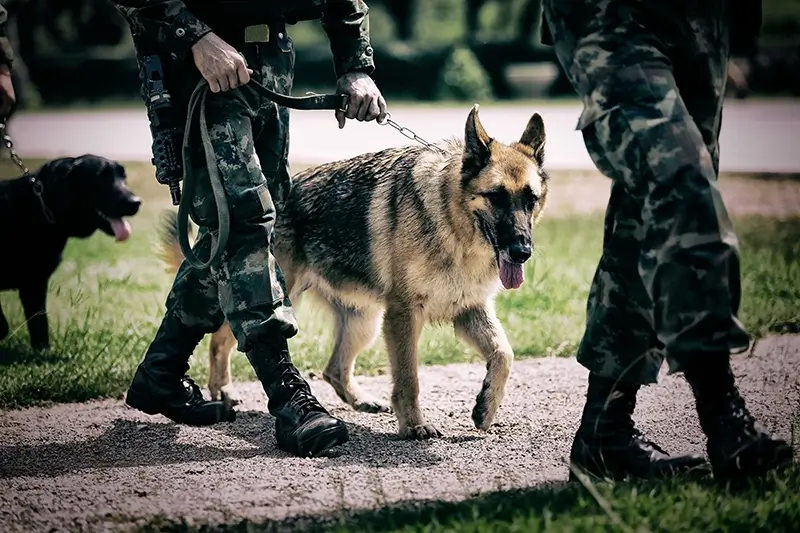
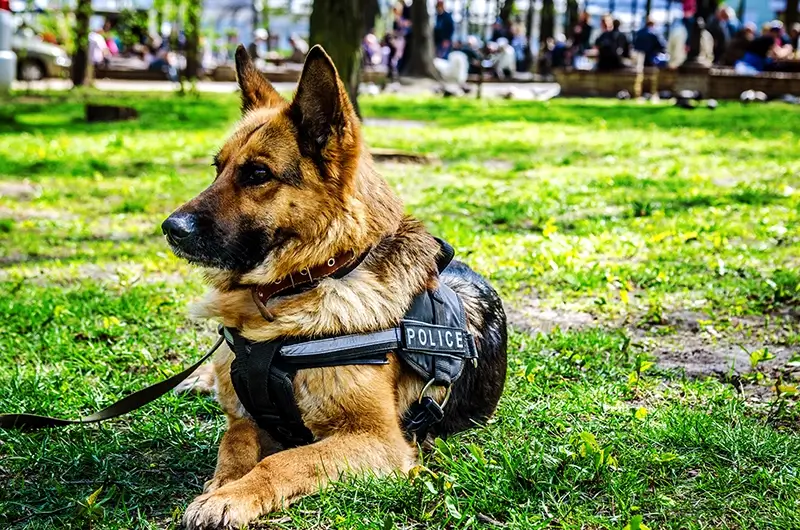
Nat Geo Wild has launched a new show, “Alpha Dogs,” which features German Shepherd and Belgian Malinois working dogs, and we’ve been getting some questions about the show and how closely it relates to the work we do at Protection Dogs Plus. Simply put, the dogs you see on “Alpha Dogs” are police and military dogs and they have very little in common with personal protection dogs.

There are some similarities here: we do train German Shepherds and Belgian Malinois to bite, we do encourage dogs with some of the same techniques that you see on the show (such as motivating dogs by using their food and toy drive), and we do condition dogs to be comfortable working around gunfire and other distractions. But to paraphrase the show itself, “these (military dogs) aren’t pets.”

The truth is that military and police dogs aren’t good for homes, let alone children. Police and military dogs are selected for different traits than personal protection dogs; unlike police and military dogs, we look for a combination of power and friendly, stable temperaments. This complete package is much harder to find than dogs that are simply good at attacking targets or searching by nose. We know this because we have had experience in training dogs for other purposes than just personal protection, and can say that very few of the dogs chosen for police or military work would be the right fit for our program- probably around 5% of them. In “Alpha Dogs,” the dogs shown have little to no functional obedience training when they’re considered “finished” and many of the handlers on the show don’t seem to have control.

The trainers on “Alpha Dogs” are professionals, but they’re in a different industry than us, and therefore their knowledge and background is different than ours. They get dogs and usually turn them over in a matter of weeks, as they do not have to spend as much time training their dogs for obedience and sociability as we do. We train our dogs for months with every situation imaginable, and the personal protection dogs we train epitomize control.

This morning, for instance, we worked with Rex on one of our most valuable exercises: “turning off.” It’s one thing to get a dog to turn on aggressively against an attacker, but it’s another thing to make that same dog friendly on command. The dogs in “Alpha Dogs” are shown biting and then refusing to “turn off” or release their bite. Rex, like all of our protection dogs, can be told to instantly stop displaying aggression and release his bite on command. The scenario goes like this: we send Rex off-leash to bite a decoy with undercover equipment, and a second before Rex hits his target we give him the command to lie down. There’s no delay- Rex is “off” now, the decoy is safe and the dog can now be approached and pet. Our dogs do not have to be redirected, or given a ball to be rewarded each time because we’ve taken our training past that point and we’ve transitioned them to respond to a verbal command said in a normal tone.

We wouldn’t be surprised to see a reality show about personal protection dog training, but even that wouldn’t give you an idea of what happens at Protection Dogs Plus. TV producers like drama and that’s just not what we’re about. We take precautions so that our dogs aren’t biting the hand that holds them. We raise dogs to be a pleasure in your home, not just to look extreme for the cameras. And when it comes to training, we never rush the process or compromise our values.

Take a look at our fully trained protection dogs for sale, and see what functional training looks like on our Videos page.

We’re Back from Buying Dogs for Protection Training

We’re fresh off a trip to Europe, but this was no vacation. In six days, we drove over 1,300 miles to 6 countries to test over 100 dogs. Of those dogs, we decided to take only a small handful into our protection dog training program. That’s a lower acceptance rate than Columbia and Harvard! It’s not that there’s any shortage of nice German Shepherds or Belgian Malinois in Europe, it’s just that the best personal protection dogs need to be well-rounded in everything- health, temperament and protection. We don’t train police dogs or military dogs, so it’s not enough for a dog to bite a sleeve or turn on aggressively. They need to be friendly and obedient, and they need to accept even a five year old as their master. Finding a dog with one or two exceptional qualities is easy, but finding one with all of them takes legwork.

We want to raise the best dogs for personal protection possible, so we’re highly selective about which dogs to bring back. At the same time, we realize that any dog we pick will be given months of our intensive training before going to a home. Great dogs aren’t born, they’re made, and we know how to make them great. To do this though, we need to start with a certain amount of raw talent. What are some of the things we’re looking for? We check for things like making sure they won’t back down from an aggressor, that they have tenacity, and that they are accepting of children and other dogs. Because our program is very physically demanding, we make sure that all of our dogs are healthy and in prime physical condition.

In Europe, we also seek and select dogs that fit client requests. If you’re interested in a different dog than our current protection dogs for sale, we can keep you in mind for our next trip. Contact us today to let us know what your needs are.

The Perfect Fit for Apartment Life

You might not think that a protection K9 would be a good fit for life in an apartment or condo. These buildings can be on the smaller side, after all, and most complexes are heavily trafficked by people and other dogs. Some landlords seem like they’re just waiting for a chance to hand their tenants a leash violation. So are you asking for trouble by bringing a dog into your rental for security? If your building allows dogs and your companion has the right training, absolutely not! The size of your home, apartment, or condo isn’t important because your protection dog will be selected and adjusted to fit your lifestyle.

While clients in the countryside often request that their dogs alert them whenever someone is at the door, this would cause many false alarms in a building with narrow corridors and thin walls. In this environment, custom trained personal protection dogs will easily top guard dogs that don’t have the same advanced training or control. Your dog will only bark on command. When you’re in common areas you won’t have to worry about unpredictable behavior around other tenants, their children or their dogs. When you’re in your room, you can feel prepared for a forced entry situation, and you’ll be able to enjoy the loving company of the most hassle-free apartment dog possible.

During the matching process, we’ll find a German Shepherd or Belgian Malinois that will not just fulfill your protection needs, but match your energy level as well. There is a misconception that a working line dog will be hectic and high energy in a smaller space, but our dogs offer energy on demand. Even though they are fast and powerful in dangerous situations, they move with grace and care around the apartment.

Each of our dogs are trained thoroughly in off-leash obedience, so you won’t be pulled down the stairs and your neighbors will see that you have a friendly dog with perfect manners. The usefulness of off-leash exercises extends to your own living spaces, too. The “place” command will keep your dog exactly where you want him or her, which is great when you’re cleaning up or when you have company coming over. Your dog will stay off the furniture and away from unattended food. Our training is designed to put your mind at ease, from worry-free daily life to knowing that you’re secure at home.

Do you want to find out how our training can be personalized for your apartment or condo? Send us a message to tell us what your needs are.

Military Working Dogs Still Classified as “Equipment”

By Dan Moore

Whether you own a protection dog, other working dog or just a pet dog, you can probably get behind the three tenets of the Canine Members of the Armed Service Act (H.R. 4103). The first part of the act would authorize the secretary of the appropriate military department to transport retiring military working dogs to the 341st Training Squadron or place them for adoption. Historically, military working dogs have been abandoned, given away or euthanized. The second part of the act would task the Secretary of Defense with providing a veterinary care system for retired military working dogs once the dogs are adopted. The final provision holds that military working dogs would be classified as members of the armed forces instead of “equipment,” and decorated/recognized for being killed in action or performing extraordinary acts in service of the country.

The act passed the House of Representatives and Senate, but it was appended to the National Defense Authorization Act for 2013, which was signed into law at the end of 2012. Unfortunately, the entire resolution wasn’t left intact. The good news is that military working dogs will not be abandoned or given away overseas. Instead they will be transported back to the United States once their service is over, and veterinary care will be provided. The bad news is that these canine heroes will still not be classified as members of the armed forces, and instead will be considered “equipment” or “surplus equipment.”

Protection dog owners can tell you that their companions are more than guard dogs or security systems- they’re a member of the family. Handlers in the military will take comfort in knowing that their comrades will be cared for and not left behind after duty, but it seems wrong to ask so much of these dogs without considering them a part of the armed forces. There is a growing movement to remedy this issue, and we’ll be on the lookout for any developments with military working dogs, since we consider them close cousins to the dogs we train for family security.

Video Update: Advanced Protection Dog Exercises with Curtis

If you saw our original video of Curtis performing in different training exercises, be sure to watch the updated version we posted today. The video now features an additional two minutes of Curtis handling multiple attackers, guarding objects and more. We couldn’t be happier with how Curtis has progressed, and if you want to take your dog’s training to the next level, read about our puppy and adult protection dog training programs.

Kidnappings Threaten Travelers to Mexico, Brazil, Colombia and More

Rex is quick to handle carjacking and kidnapping scenarios in his protection work. (Video)

Kidnapping is a major part of our protection dog training curriculum, but we don’t just teach our dogs to be the best protection for kids and adults in their homes. This type of crime is a real concern for travelers and executives, and we train our dogs to perform at any moment and in any environment.

Central and South America are closely associated with kidnappings, and according to Castle Rock International, the places you are most likely to be kidnapped in are Mexico, Brazil, Colombia, Venezuela, the Philippines, Nigeria, the Chechnya Region of Russia, Afghanistan, Iraq and Haiti.

Kidnappings for ransom or extortion are more common than you might think. Some insurance companies offer policies to international travelers that will reimburse holders for costs associated with a kidnapping, from ransoms to mercenary teams.

At Protection Dogs Plus, we have our own idea of insurance against kidnappings.

Criminals take advantage of tourists and travelers who are already out of their element, and danger could lurk around the next corner or stoplight. A criminal’s opportunity presents itself in ways you might never expect. For instance, while some modern cars will automatically lock their doors when moving, many will automatically unlock them again in park, and other cars have no automatic lock feature at all. This inconsistency means that if you’re driving an unfamiliar rental car in a strange place, you aren’t likely to always remember to lock the doors.

When we’re training for carjacking scenarios, we’re also training our protection dogs for kidnapping situations like the one that befell Eduardo Garcia Valseca near San Miguel de Allende in central Mexico:

“A truck crashed into the back of their Jeep, pinning them. Masked bandits armed with pistols and hammers smashed the windows of their car and dragged them to the ground.”

One of our training exercises is to have a decoy attempt to pull the handler out through a door or window. Our protection dogs will rush to the door or window the assailant is accessing to fend them off. In many situations, just turning your dog on aggressively will deter a kidnapper from trying to gain access to the vehicle, and this protection continues when you leave the car and your dog stays by your side.

Kidnappers don’t always work alone. Our Guardian and Guardian Plus protection dogs are versed in handling situations like this one, from Nassau, Bahamas:

“As we all lay face down on the ground, we were being robbed by one man after the other tied up our tour guide. There was a lot of scuffling and a flurry of activity.”

The multiple attacker exercise allows you to decide whether to send your dog after the threat closest to you first, or the threat that poses the biggest danger at the moment (e.g. an armed threat).

As crime increases in popular destinations like Puerto Rico, we urge travelers not to take their safety for granted. Stay vigilant!

Glossary of More Advanced Protection + Obedience Exercises

Guardians like Asterix can do a lot more than smile for the camera.

By Dan Moore

Our sole purpose is to pair families with trained protection dogs that will keep them safe. We do this by taking our training to the extreme, whether it’s fully immersing the dogs in various home and public environments or teaching them the most advanced protection commands possible. In conjunction with our training levels chart, this glossary will help you understand some of the exercises our dogs are capable of.

Heel: Your protection dog stays virtually glued to your leg as you walk, giving you his or her full attention and sitting whenever you stop. Your dog will resume walking when you do.

Relaxed Heel: Similar to the heel command, your dog will stay by your side until released. The difference here is that the dog walks in a more casual way within a three foot radius of your body. This becomes a constant part of our clients’ routines- from walking down a busy sidewalk to taking dogs out to the bathroom.

Down in Motion: Even if your dog is moving at full speed, you can give the word and your dog will drop to a sit or down position.

Place: With this command you have the power to designate a place for your dog to sit or lie down on command. This is a great command to use if you’re having company over and want your dog to keep a low profile.

Food/Toy Refusal: Your dog will wait for your command before taking food or toys.

Turn On Aggressively: In a situation where you need your protection dog to fend off an attacker, you can give the command to “turn on.” Your dog will enter a state of heightened alertness while baring his or her teeth, growling and barking and monitoring the situation. Your dog will await your command and will only actually pursue an attacker if you give the order.

Turn Off: When the situation is defused and you want your protection dog to return to its normal gentle self, you can give your dog the command to “turn off.” Your dog will not show any aggression again until you request it.

Target Parts of Body: We train our protection dogs to go after more than a sleeve or suit, and to be able to leverage their power and fight with technique. If you give your dog the command to attack, he or she will target whichever part of the body will neutralize the threat quickly.

Overcome Obstacles: Our protection dog training takes obstacles into account. From climbing walls, hills, rocks and furniture to jumping out of and into cars and windows, we prepare our dogs to size up a situation and find the best path forward, all while maintaining a tight focus on the threat and any additional commands given by the handler. Exposing our dogs to a variety of obstacles and environments minimizes distraction and improves their response time.

Fighting Skills: Guard dogs and protection dogs may be most known for barking and biting, but our approach is more holistic: we teach our dogs to use their entire body as a tool to fight against a threat. By using a muzzle to remove the option of biting, our dogs learn to tenaciously wrestle, scratch and claw until the handler turns them off.

Turn of Passive Threat: Your dog will turn on aggressively against even a passive threat on your command. A common mistake in protection dog training is to only prepare a dog to go after someone moving in a threatening way. The problem here is that the dog is only conditioned for a very specific set of circumstances. Someone can threaten you without any sudden or imposing movements. Our training is designed so that you can ask your dog to show aggression and deter the threat before they even have a chance to escalate to physicality.

360° Secure: Your dog will turn on aggressively against an attacker (showing teeth, barking and growling) while staying glued to your body in a tight circle, protecting you from attack in any direction. The dog will only bite if you give an additional command, or if the threat attempts to touch you or intrude into this protective barrier.

Guarded Escape: Once you have given your dog the command for 360° Secure, you can walk away from the situation. Your dog will remain in a heightened state of alert until you’re safe and give the command to turn off.

Stealth Mode: Under this command, your dog will be covertly primed for action and waiting intently for an additional command. If you have a gut feeling that you’re in a potentially dangerous situation but do not want to escalate things by turning your dog on aggressively, you can simply put your dog in this standby command.

Multiple Attackers: In the event that there are multiple threats to your safety, you can send your protection dog on a specific person. Your dog will make eye contact with you and follow the signal you give. You can recall your dog at any time, and you can have your dog switch to a different threat mid-bite. By using your judgment and selecting the most prominent threat at any given time, you are given the most control possible in a dangerous situation.

You can see these exercises in action by watching our videos, and be sure to contact us for any additional information.

TX, NY, IL and AZ Have Cities with Most Burglaries (Yahoo)


Yahoo! Finance has compiled an interesting list of the American cities with the most burglaries. Since burglaries are one of the main reasons that people guard their homes with protection dogs, we thought it was worth discussing here. Protection Dogs Plus began in Texas, so we’ll start off with the Lone Star State’s crime stats:

Dallas is the center of the Dallas-Fort Worth-Arlington metropolitan area, an area which had a gross metropolitan product of $374 billion, according to the Bureau of Economic Analysis. Of the 61,859 property offenses committed there in 2011, 18,727 were burglaries….the population of San Antonio had grown to 1.3 million, an increase of 16 percent since 2000. This increase is part of the overall population explosion that has been going on in Texas in the new millennium. This growing city experienced 80,868 property offenses in 2011, of which 15,334 were burglaries.

San Antonio seems to be doing a great job of bringing in new residents but not a great job of keeping out crime. Let’s head a couple hundred miles east and see how Houston is doing:

Houston…saw 108,336 property offenses in 2011, of which 68,596 were categorized as “larceny-theft” and 12,281 were motor vehicle thefts…27,459 were burglaries, which puts the city at the top of the list. So if you live there, lock your doors when you go out at night.

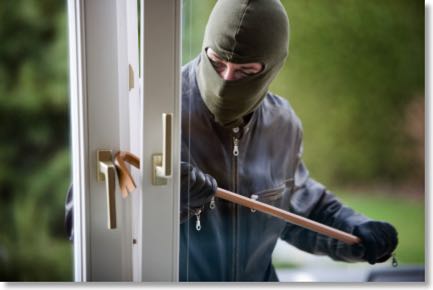
Locking your doors is never a bad idea, but let’s remember that criminals are no strangers to breaking and entering. There are a variety of ways to bypass door and window locks: cutting or breaking glass, lock picking, brute force and so on. Wouldn’t it be better if we could stop the bad guys while before they’ve even broken in? We think so—that’s why we train our protection dogs to block off doors and windows and show aggression toward would-be intruders. Our dogs have the bite to back up their bark, but most criminals in their right mind would be deterred from escalating things at that point.

When it comes to sheer number of crimes, this next city surpasses San Antonio, Houston and Dallas:

Chicago…saw a whopping 118,239 property offenses in 2011, of which 26,420 were burglaries.

Let’s also remember to keep things in proportion: the article states that Detroit saw 15,994 burglaries in 2011. That’s around 10,000 fewer than Chicago, but consider that the population of Chicago is almost 4 times greater.

Indianapolis: Among the 46,967 property offenses reported in 2011, 15,122 were burglaries. There were also 26,588 offenses categorized as “larceny-theft” and 5,257 motor vehicle thefts.…In 2011, Columbus (Ohio) experienced 49,043 property offenses, 15,169 of which were burglaries.

One reason that guard dogs are so sought after in places like Texas is that neighbors are often miles apart and there are no friendly eyes to keep watch over properties. But the statistics from larger cities like Chicago and Indianapolis speak to the fact that neighbors are by no means guaranteed protection. You have to question if neighbors would intervene or even notice a property crime in progress. In 2011, Los Angeles, California saw 17,264 burglaries and New York City saw 18,159.

Since we’re located in New Hampshire on the Massachusetts border, we have a great opportunity to prepare our dogs for a variety of settings. When we sell a protection dog, it doesn’t matter if they’re going to Washington, D.C. or Sugarland, Texas, because our dogs have done protection work in both the woods of New Hampshire and the alleys of cities like Boston, Newburyport and Salem. We test our dogs’ off-leash obedience in crowds and with distractions such as cars and bikes. Some of our dogs are specifically selected for their mellow, low energy personalities- perfect for life in an apartment or small house.

If you’d like to take a look at the rest of the list, visit 

Should You Raise a Puppy for Protection or Buy a Fully Trained Protection Dog?


Raising your own protection dog is possible, but it’s also very difficult. It takes the combination of a dog with the drives needed for protection work and an owner with a lot of time- and more importantly, knowledge- to raise a dog that can one day offer functional protection.

We want to be very clear about two things:
  1. We don’t recommend that people try to raise a protection dog on their own.
  2. We understand why someone would want to raise their own protection dog and we’re here to help those who do.

Having said that, we can start talking about the deciding factors between raising a protection puppy and buying a trained protection dog.

Why might a person try raising their own protection puppy?

Nothing is more exciting for a family than bringing home a new puppy. The bond between dogs and their families is remarkable, and we have all seen dogs act protectively toward their owners. But we want to again dispel the notion that the instincts of an untrained dog are enough to be a security system. As we uncovered in our first post, people who were expecting their pet dogs to protect them were surprised to find that their dogs barely resisted a simulated home invasion.

Another reason that a person might attempt to raise their own protection dog is cost. The price tag of a properly imported and trained protection dog can be a surprise to those not familiar with the process. Consider that we visit European countries to hand select our dogs. We purchase them, ship them to the U.S., and bring them up to date on all of their vaccines. And that’s just the start. Next comes daily care, feeding and training by multiple trainers in dozens of scenarios to ensure our dogs ready to become your family’s perfect home defender and companion.

What are the pitfalls associated with raising your own protection puppy?

With puppies, there are no guarantees. The only exception is that you can guarantee that housebreaking, chewed furniture, clothing and electronics will all present a formidable headache.

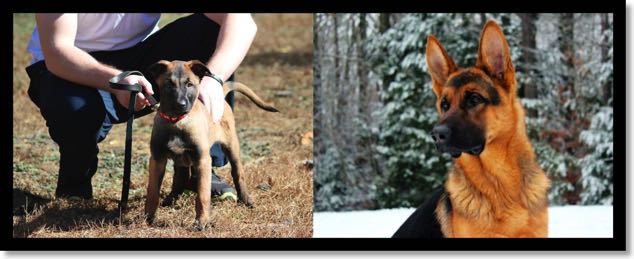
Will the puppy you bring home be healthy? Will your new dog have the natural makeup needed for personal protection? Unless you really know what to look for or have had expert guidances, chances are it won’t. That’s because most dogs don’t have the drive and tenacity needed for this kind of work. It takes years of experience to be able to recognize puppies with potential as protection dogs. We don’t want you to end up with puppy that doesn’t fit your needs. If you’re considering buying a puppy for personal protection, contact us so that we can help you make the best decision.

If you’re lucky enough to find a puppy suitable for protection, we congratulate you on completing the first part of a complex journey! Remember though, great dogs are made, not born. Raising a puppy for protection is a completely different process than raising a pet. This undertaking is far more difficult because every single experience that you give your new dog will influence his or her ability to move forward with protection training. If you don’t handle your puppy in exactly the right way, you could stymie their progress without even knowing it. Many people trying to raise a protection puppy for the first time are left with a dog they feel attached to but that they can’t count on as a protector.

Let’s say you beat the odds and find and raise a puppy that can complete protection exercises. Can you be sure that your dog will only bite when you say so, and be loving to your friends and family the rest of the time? The socialization process needs to be treated with the same care as things like bite foundations. 99% of the time, a protection dog needs to be loving and tolerant toward people, children and other animals. Improperly socialized dogs will develop fear and aggression issues. If there is any question in your mind about this, please leave protection training to professionals. Dog bites are just too much of a liability to make this type of training an amateur hobby.

What are the advantages of buying a fully trained adult protection dog?

You want a dog that will keep your home safe while you’re away and lovingly greet you when you come home from your job. Making that a reality is our job. When you buy a protection dog from us, you’re getting a great dog without the guesswork. You already know that the dog is healthy and fully capable of being an obedient member of your family. You know that your dog can excel in a protection situation, and you know that you never have to worry about the dog with your kids. Buying one of our trained protection dogs will save you frustration and expense. We show you exactly what you’re getting and we back it up with our guarantee.

Just how does an adult dog become part of your family?

We hear time and time again from clients that they cannot believe how quickly their new protection dog bonded with their family. In the first day of delivery, you’ll see your dog begin to learn your tones and feel comfortable in your home. Within days, our trainers are able to give control to even the youngest members of the household. The dog quickly adapts to the routine of the home environment and the preferences of its new owners. If you have purchased or adopted adult dogs in the past, this might seem very foreign to you. But remember that these are fully trained dogs that have lived in the homes of professional dog trainers, ’and it’s not luck that makes them a good fit for homes. After meticulously selecting each of our dogs, we pair you with the one that will match your lifestyle and spend weeks on end making sure they are ready for delivery.

If the option of buying a fully trained protection dog sounds like the best fit for your family, click here to see our German Shepherds and Belgian Malinois for sale. Remember that we import and train other breeds by request.

I understand the risks and I’m still interested in raising a puppy for protection.

We want to help. Contact us so that we can minimize your risk and maximize your chances of raising a strong protection dog. Click here to learn more about our protection dog training programs for puppies.